

For many San Diego homeowners, the biggest challenge isn’t deciding whether a pool is worth it—it’s figuring out the most innovative way to pay for it without squeezing monthly cash flow. Pool projects can include more than the shell and waterline tile. Think permitting, excavation, steel, plumbing, electrical, decking, drainage, retaining walls, and landscaping to make the yard feel complete. In Southern California, site conditions such as slopes, limited access, or soil issues can also affect the final number.
That’s why “financing” is less about picking one loan type and more about matching a payment plan to how your project will be built and billed. Some options give you a lump sum upfront. Others let you draw money over time. Some are secured by your home (often with lower rates but higher risk), while others are unsecured (usually faster and simpler, but frequently costlier).
The right choice depends on three things: your timeline, your equity and credit profile, and the predictability of your costs before construction starts.

Home Equity Loans vs HELOCs for Pool Projects
Two of the most common paths are a home equity loan and a home equity line of credit (HELOC). A home equity loan typically provides a lump sum of disbursement with a fixed payment schedule. A HELOC works more like a credit line you can draw from as needed—often useful when costs hit in phases. The CFPB explains that a home equity loan is a specific amount borrowed against your equity, while a HELOC is a revolving line of credit secured by your home
Why this matters for pools: many builds aren’t “pay once and done.” There may be deposits, progress payments, change orders, and finishing work that lands later than expected. A HELOC can be convenient when spending is staggered, but it often has variable rates, so that payments can change.
Important reality check: any loan secured by your home carries serious consequences if you fall behind on payments. The CFPB warns that if you can’t repay a HELOC as agreed, you could lose your home.
For homeowners who value payment stability, a fixed home equity loan can feel more predictable. For homeowners who need flexibility, a HELOC can match the construction rhythm—if the budget and repayment plan are disciplined.
Personal Loans and Contractor Financing
If you’d rather avoid using your home as collateral, a personal loan can be a straightforward option. You receive a lump sum, and payments are typically fixed over a set of terms. Many homeowners like speed and simplicity—especially if they want to start quickly and don’t want appraisals or lien-related complexity.
Consumer finance outlets commonly list personal loans alongside home equity loans and HELOCs as standard ways to fund a pool, and they note that some pool companies offer in-house financing that can be convenient but may cost more overall.
Contractor or dealer-style financing varies widely. Some programs are competitively priced; others are designed to win the sale and can include higher rates, fees, or promotional terms that reset later. If you go on this route, focus on the total cost (APR, fees, and term), not just the monthly payment. Also, confirm whether the financing is tied to construction milestones or requires specific scheduling.
Personal loans can be a good fit for smaller pool scopes, faster timelines, or homeowners who want precise payoff dates. They may not be ideal for large, custom builds where flexibility is needed, and the total budget can shift.
Cash, Savings, and Hybrid Payment Plans
Paying cash is the cleanest option if it doesn’t drain your emergency funds. But “cash” doesn’t have to mean “all at once.” Many San Diego homeowners use a hybrid strategy: a down payment from savings, plus financing for the remaining balance. This can reduce the amount you borrow, shorten the payoff timeline, and keep monthly obligations manageable.
A practical approach is to decide your maximum comfortable monthly payment first, then work backward to a loan amount and term. From there, you can choose how much you’d like to put down to reach that monthly target. Hybrid plans also help when you’re balancing multiple priorities—like a kitchen update, roof work, or HVAC replacement—where keeping reserves matter.
If you plan to pay in phases, align your funding clearly with your build schedule. A lump-sum loan can work well if your contract pricing is firm. A line-of-credit approach may be better if you expect upgrades such as automation, lighting, additional decking, or landscape work later.
Costs Beyond the Pool and How to Budget Smarter
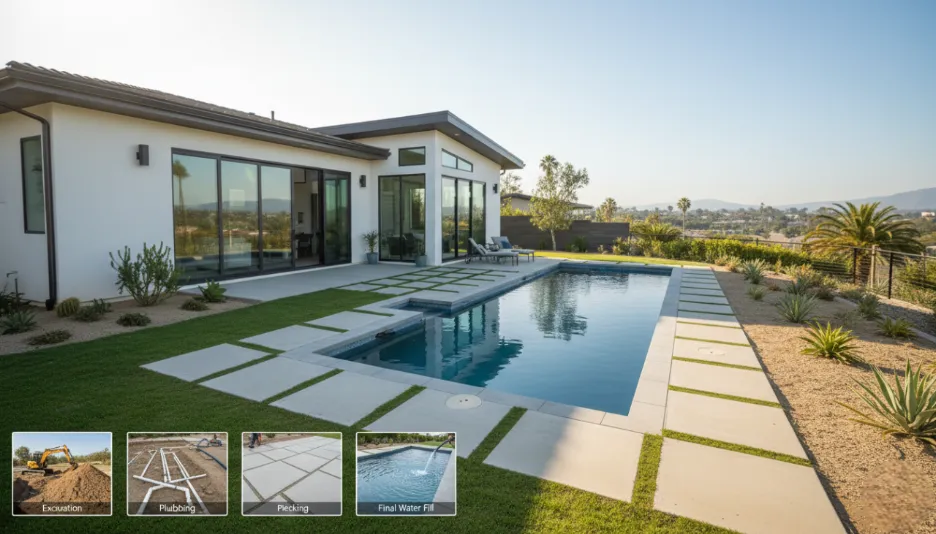
The fastest way for a pool budget to get uncomfortable is forgetting the “not-a-pool” costs. In Southern California, hardscape and drainage can be just as significant as the water feature itself—especially for small yards where every square foot has to work.
Smart budgeting comes down to two habits:
- Get a realistic range early. Ask your builder to separate must-haves from nice-to-haves. Clear line items make it easier to protect your budget when decisions pop up mid-build.
- Built in a contingency. Even with excellent planning, excavation surprises, access constraints, or design changes happen. A contingency prevents you from reaching for high-interest credit at the worst moment.
If you’re borrowing, it helps apply a bit of flexibility rather than the bare minimum—without over-borrowing. NerdWallet’s guidance on financing a pool emphasizes first determining cost with contractor quotes, then comparing loan options against that amount.
And avoid funding a large portion of a pool with credit cards unless you have a short-term payoff plan. Revolving balances can become expensive quickly, and variable rates can shift at the wrong time.

Choosing the Best Fit and What to Ask Before You Sign
The “best” option is the one that aligns with your risk tolerance, timeline, and long-term plans for the home. Home equity solutions can offer favorable pricing but carry higher stakes because your home secures the debt. Personal loans can be faster and simpler, but rates and terms depend heavily on credit and income.
Before you commit, ask these practical questions:
- Is my project scope stable enough for a lump sum, or will I need flexible draws?
- What’s my target monthly payment, and how does it change if rates rise?
- Are there origination fees, prepayment of penalties, closing costs, or appraisal requirements?
- If using home equity, am I comfortable with the risk and the repayment schedule?
- Can I keep an emergency fund intact after the down payment and initial bills?
Tax considerations may also apply in some cases. The IRS notes that interest in home equity loans and lines of credit is deductible only if the funds are used to buy, build, or substantially improve the home that secures the loan, and other requirements are met.
With a clear budget, a realistic timeline, and the proper financing structure, a San Diego pool project can feel far more manageable—and a lot less stressful—than homeowners expect at the start.
Schedule Your Free Pool Design Consultation Today
Dreaming of a backyard oasis? Majestic Pools & Spas—San Diego’s award-winning custom pool designer and builder—is here to make it a reality. Schedule your free, no-obligation consultation today and take advantage of our limited-time offer: a complimentary custom pool design when you choose to build with us. Start your journey to a stunning new pool by booking online
Majestic Pools & Spas (Visit our showroom)
- Address: 9951 Businesspark Ave Suite A, San Diego, CA 92131
- Phone: +1 858-790-9919
- website: https://www.majesticpools.net/

