

Testing your swimming pool water may only take a few minutes but understanding what those numbers actually mean is what helps you maintain clean, comfortable, and healthy water. A test strip or liquid testing kit can reveal a lot about what is happening below the surface, from whether your sanitizer is working effectively to whether your water could be damaging pool equipment.
For homeowners in San Diego and throughout Southern California, regular water testing is especially important. Long stretches of sunshine, warm temperatures, evaporation, heavy pool use, coastal conditions, and occasional wind can all affect water chemistry faster than many pool owners expect.
The good news is that you do not need to be a chemist to understand your results. Once you know what the major readings represent and how they influence one another, maintaining balanced water becomes much easier.
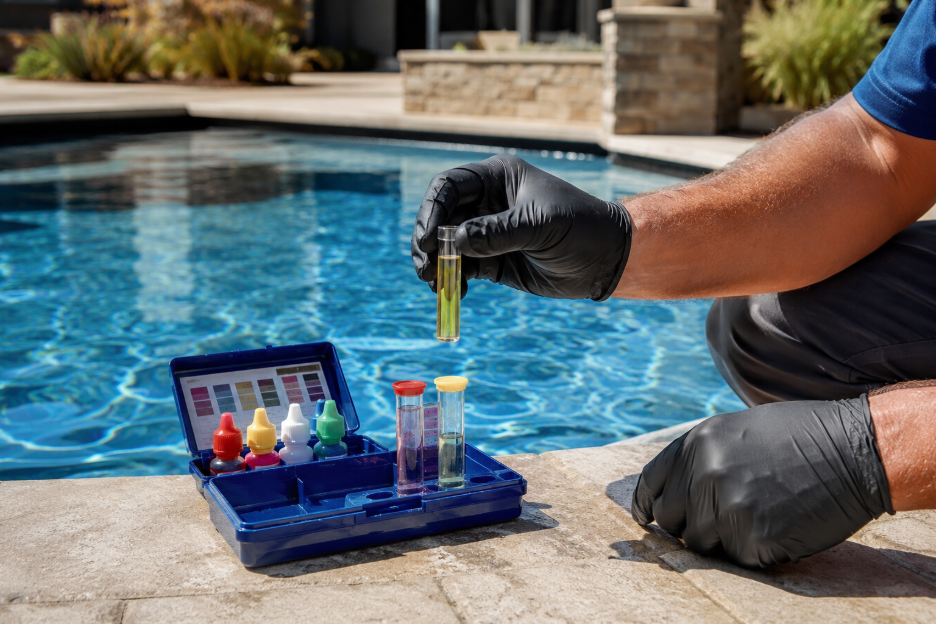
Start With the Most Important Pool Water Readings
A typical pool water test measures several chemical levels at once. Depending on the testing method you use, you may see readings for chlorine, pH, total alkalinity, calcium hardness, and cyanuric acid.
Rather than treating each result as an isolated number, think of your pool chemistry as a connected system. A change in one area can influence another.
Free chlorine shows how much active sanitizer is available to destroy bacteria and control algae. If the level becomes too low, the pool may become cloudy or develop algae. Excessively high levels can make swimming uncomfortable and may contribute to irritation.
pH measures how acidic or basic the water is. Most swimming pools perform best when pH stays around 7.2 to 7.8. Water outside this range can affect swimmer comfort, sanitizer efficiency, and pool surfaces.
Total alkalinity helps stabilize pH. When alkalinity is too low, pH may fluctuate quickly. When it is too high, adjusting pH can become difficult.
Calcium hardness indicates the amount of dissolved calcium in the water. Too little calcium can make water aggressive toward certain surfaces, while excessive calcium may contribute to scaling.
Cyanuric acid, often called stabilizer or conditioner, helps protect chlorine from being rapidly broken down by sunlight.
Understanding these core measurements gives you a clearer picture of your pool's overall condition.
Understand What Chlorine and Sanitizer Levels Tell You
Sanitizer is one of the most important parts of maintaining safe, clear swimming water. In residential pools, chlorine is the most common sanitizer, although some systems use saltwater chlorine generators or other supplemental technologies.
When reviewing a water test, pay attention to the difference between free chlorine and total chlorine.
Free chlorine represents the chlorine that is still available to sanitize the water. Total chlorine includes both available chlorine and chlorine that has already reacted with contaminants.
If there is a noticeable difference between these readings, combined chlorine may be present. This can sometimes be associated with a strong chemical smell or swimmer discomfort. Interestingly, a strong "chlorine smell" does not necessarily mean there is too much effective chlorine in the pool.
Southern California conditions can make sanitizer management particularly important. San Diego receives abundant sunshine throughout much of the year, and ultraviolet light naturally breaks down chlorine.
Warm weather can also increase pool use and encourage conditions that allow algae to grow more quickly when sanitizer levels fall.
Testing regularly allows you to spot changes before they become visible with problems. If chlorine consistently disappears faster than expected, the cause may involve inadequate stabilizer, heavy swimmer use, organic debris, algae growth, or another water-balance issue.
Know Why pH and Alkalinity Need to Work Together
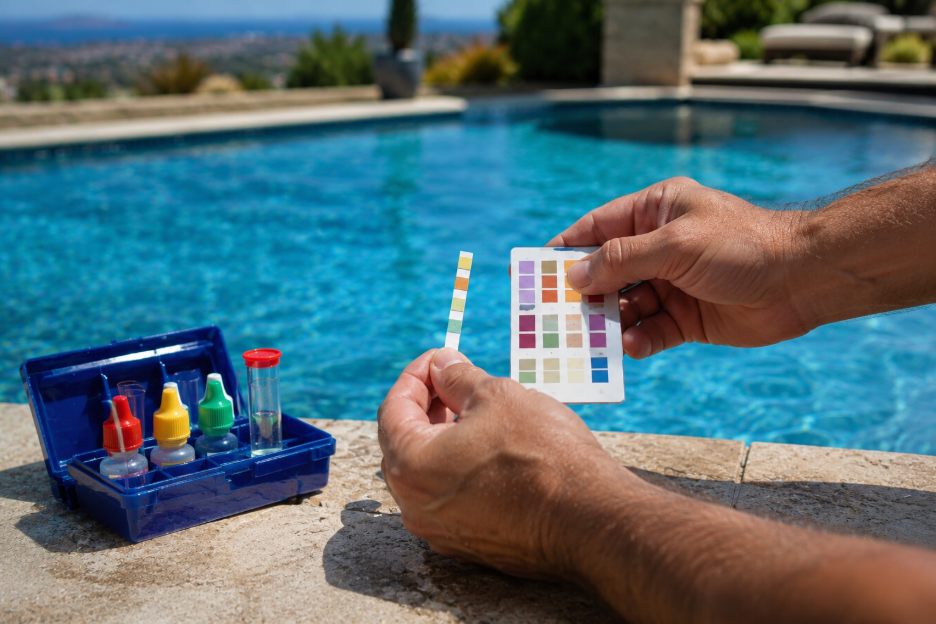
Pool owners often focus heavily on chlorine, but pH and total alkalinity are equally important for maintaining stable water.
The pH level affects almost everything happening in your pool. When pH becomes too low, water becomes more acidic. This may contribute to corrosion of metal components, deterioration of certain pool surfaces, and swimmer discomfort.
When pH rises too high, chlorine becomes less effective and mineral deposits or cloudy water may become more likely.
Total alkalinity acts as a buffer that helps prevent sudden pH changes. Think of it as the support system that keeps pH from moving dramatically every time something enters the pool.
This relationship is why repeatedly adjusting pH without checking alkalinity can become frustrating. You may lower or raise the pH only to find that it quickly moves outside the desired range again.
In San Diego, evaporation can also influence water chemistry. When pool water evaporates, minerals and other dissolved substances remain behind. Fresh water added to replace evaporation can further change the chemical balance depending on the chemistry of the local water supply.
If pH seems difficult to control, look at the broader chemistry rather than continually adding a single adjustment product.
Pay Attention to Calcium Hardness and Mineral Balance
Calcium hardness is sometimes overlooked because its effects are not always immediately visible. Over time, however, an improper calcium balance can affect pool surfaces, plumbing, tile, and equipment.
When calcium hardness is too low, water may become aggressive and seek minerals from surrounding materials. This can be particularly concerning plaster, concrete, or other mineral-based pool finishes.
When calcium levels become too high, scaling may occur. You might notice rough deposits around the waterline, white residue on tile, buildup inside equipment, or cloudy-looking water.
Southern California pools can be especially susceptible to mineral accumulation because evaporation is common during warm, dry weather. Water evaporates, but dissolved calcium and minerals do not. As replacement water is repeatedly added, mineral concentrations can gradually increase.
This is one reason simply checking chlorine and pH may not provide enough information about the long-term health of your pool.
Calcium hardness should be evaluated alongside pH, alkalinity, temperature, and other factors. Pool professionals often consider the overall saturation balance of the water when determining whether conditions are likely to encourage scaling or corrosion.
Regular testing makes it easier to identify a developing mineral problem before deposits become difficult or expensive to remove.
Look Beyond Individual Numbers When Something Seems Wrong

A common mistake is assuming that one unusual reading automatically identifies the entire problem.
Pool chemistry is interconnected. Cloudy water, for example, could result from inadequate sanitizer, filtration problems, high calcium levels, poor circulation, an incorrect pH balance, or several issues occurring together.
The same principle applies when algae appear. Adding more chlorine may be necessary, but it is also important to understand why sanitizer levels became inadequate in the first place.
When reviewing your test results, consider a few questions:
- Has the water recently become cloudy or changed color?
- Has the pool experienced unusually heavy use?
- Were there recent rain, strong wind, or significant debris?
- Have temperatures increased substantially?
- Has a large amount of fresh water recently been added?
- Is the filtration system running normally?
- Have chemicals recently been added?
The timing of your test also matters. Testing immediately after adding chemicals may produce results that do not accurately represent normal pool conditions. Allow adequate circulation according to the chemical manufacturer's directions before retesting.
Consistency is useful as well. Test from approximately the same location and depth each time, away from return jets and chemical feeders.
Most importantly, keep track of results over time. A single test provides a snapshot, while several weeks of records reveal trends. Gradually rising calcium or consistently unstable pH can be easier to address when detected early.
Know When Your Pool Water Needs Professional Attention
Home testing is an excellent part of routine pool maintenance, but there are situations where professional water analysis can provide valuable additional information.
If your readings repeatedly move outside recommended ranges despite regular adjustments, there may be an underlying issue that basic testing does not reveal.
Persistent cloudy water, recurring algae, staining, scale buildup, unusual discoloration, or rapidly changing sanitizer levels are all reasons to investigate further.
A professional can evaluate more than chemical readings alone. Pool circulation, filtration, equipment condition, water temperature, chemical dosing practices, and the condition of the pool surface may all contribute to water-quality problems.
This broader approach can be particularly valuable in San Diego and Southern California, where pools often operate for much of the year. Extended swimming seasons mean water chemistry, and equipment require consistent attention rather than only seasonal maintenance.
Professional testing may also provide more precise measurements than basic test strips, especially when diagnosing a recurring problem.
The goal of water testing is not simply to make every number of lands within a recommended range. It is to maintain a stable environment where sanitizer works efficiently, swimmers remain comfortable, water stays clear, and pool surfaces and equipment are protected.
Once you become familiar with your pool's normal chemistry, unusual readings become much easier to recognize. Test consistently, make measured adjustments rather than large corrections, and pay attention to trends over time.
A well-balanced pool is easier to maintain and more enjoyable to use. With Southern California's long stretches of pool-friendly weather, staying ahead of water chemistry can help keep your backyard ready whenever it is time for a swim.
Schedule Your Free Pool Design Consultation Today
Dreaming of a backyard oasis? Majestic Pools & Spas—San Diego’s award-winning custom pool designer and builder—is here to make it a reality. Schedule your free, no-obligation consultation today and take advantage of our limited-time offer: a complimentary custom pool design when you choose to build with us. Start your journey to a stunning new pool by booking online
Majestic Pools & Spas (Visit our showroom)
- Address: 9951 Businesspark Ave Suite A, San Diego, CA 92131
- Phone: +1 858-790-9919
- website: https://www.majesticpools.net/

